
Julie Marie Wade
CLIFFSNOTES FOR HORTICULTURE
Orchids are difficult. Everyone knows this. The choice is not whether to find the orchid beautiful but whether to find the orchid worth it. Your orchid will die—likely sooner than later—but always eventually. What can I say? Sometimes mortality is a buzzkill, but always mortality is a kill. Of course sometimes orchids are merely dormant, mistaken for dead. As with humans, there are bloom cycles, and there are rest cycles. When we moved here, to Dania Beach, we were given an orchid as a housewarming gift. She was haughty, fickle, impossible (I thought) to please. She did not want to “grow where planted,” despite the popularity of the phrase. She was not interested in being doused, preferred to be misted instead. And other idiosyncrasies. Of course we only inferred these things, since the orchid could not state her wish. Humans are free to say whatever they want, to name their desires, bald and true, but somehow they seldom do so. Human, meet orchid. You have a lot in common. I read that Raymond Burr, the man who played Perry Mason on TV, lived a closeted life in which he tended hundreds of orchids. They became an obsession. Being closeted is more difficult than caring for an orchid. I speak from experience. Orchids demand patience, but the closet demands obliteration. Orchids are particular about light, and the closet admits none. Darkness is all shade. Go ahead: Google “orchid.” The first result says, “A plant with complex flowers that are often showy or bizarrely shaped.” It’s not exactly a rave review, is it? They have a “large specialized lip (labellum) and frequently a spur.” Not especially flattering, but there’s a neutral accuracy here I like. Strangest still: “Orchids occur worldwide.” It’s the verb choice—occur. Humans also occur worldwide. We will never come close to encountering all of us, which is another way of saying: We will remain forever ignorant of our own species—preferences, varietals, et al. Mastery is not possible. Unless they are showcased in a pot at the grocery store or the garden shop, I associate orchids primarily with swamps. To find an orchid “in the wild,” which is to say un-curated and out of the closet, there will be muck. There will be trudging. There will be dense clouds of insects. And other unpleasantries. An orchid sighting, even in a swamp, is not promised. It cannot be assured. Florida is swampland: complex, showy, bizarre. I appreciate its fecundity: growth upon growth; the rampant, feckless burgeoning. I will not master this place either—its humanity or inhumanity, its flora or its fauna. But mastery isn’t really the point, is it? Orchids are “valuable hothouse plants,” says the internet. The internet does not say valued but valuable. To whom? In what way? Outdoors in a Florida summer is hotter than any hothouse. Humans can wilt, too. Orchids are more expensive than roses, but they also require more care. Are they worth it? Depends. I think the best answer is always depends. Roses do not grow well in Florida. I speak from experience. Our cats were curious about the orchid and expressed their curiosity by biting at its sepals. This is one reason my partner tied the orchid to a tree. It looked dead, as predicted. All year the tree hosted squirrels and lizards, raccoons that climbed it as a ladder to the roof, blue jays that built a nest together. The orchid was a silent witness. The orchid was doused by rainstorms so vigorous they bent limbs and stripped away leaves. The orchid endured it all. Then, one day, without coaxing or anticipation, she opened again—three white blossoms, one magenta, a row of faces. They seemed to be staring right at us. “Beautiful,” we said, in our human way of stating the obvious.
JULIE MARIE WADE is Professor of English and Creative Writing at Florida International University in Miami. Her most recent collections are Fugue:An Aural History (Diagram/New Michigan Press, 2023); Otherwise: Essays (Autumn House, 2023), selected by Lia Purpura for the 2022 Autumn House Nonfiction Book Award; and The Mary Years (Texas Review Press, 2024), a memoir about The Mary Tyler Moore Show. Wade makes her home with Angie Griffin in Dania Beach.
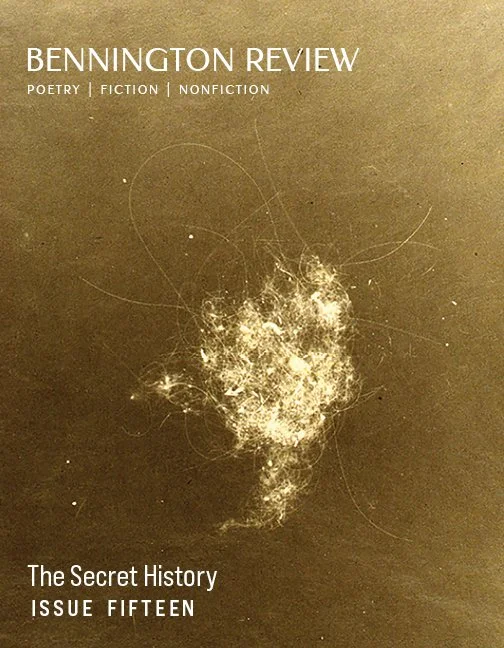
ISSUE FIFTEEN features poetry by Samuel Amadon, Malachi Black, Thea Brown, Michael Chang, Adam Clay, Jose Hernandez Diaz, Sean Thomas Dougherty, Brandon Downing, Kami Enzie, Angie Estes, John Gallaher, Rachel Galvin, Matthew Gellman, Bob Hicok, Domenica Martinello, Julia Anna Morrison, Mark Nowak, Allan Peterson, Elizabeth Robinson, David Roderick, Mary Jo Salter, Rob Schlegel, Will Schutt, Donna Stonecipher, Rodrigo Toscano, Noah Warren, Phillip B. Williams, and Stella Wong; fiction by Aimee Bender, Amelia Gray, and Keith Lesmeister; creative nonfiction by Su-Yee Lin, Philip Metres, and Kim Gek Lin Short; and Donna Stonecipher in conversation with Camille Guthrie.